
Political Party Responses: Family Violence and Sexual Violence Policy Questions 2026
In August 2026, Aviva provided political parties and relevant spokespeople with its briefing, Tāngata Whaiora Experiences of Government Policy and System Change, highlighting concerns raised by frontline family violence and sexual violence practitioners about the impact of policy, funding and system pressures on victim/survivors, tamariki and whānau.
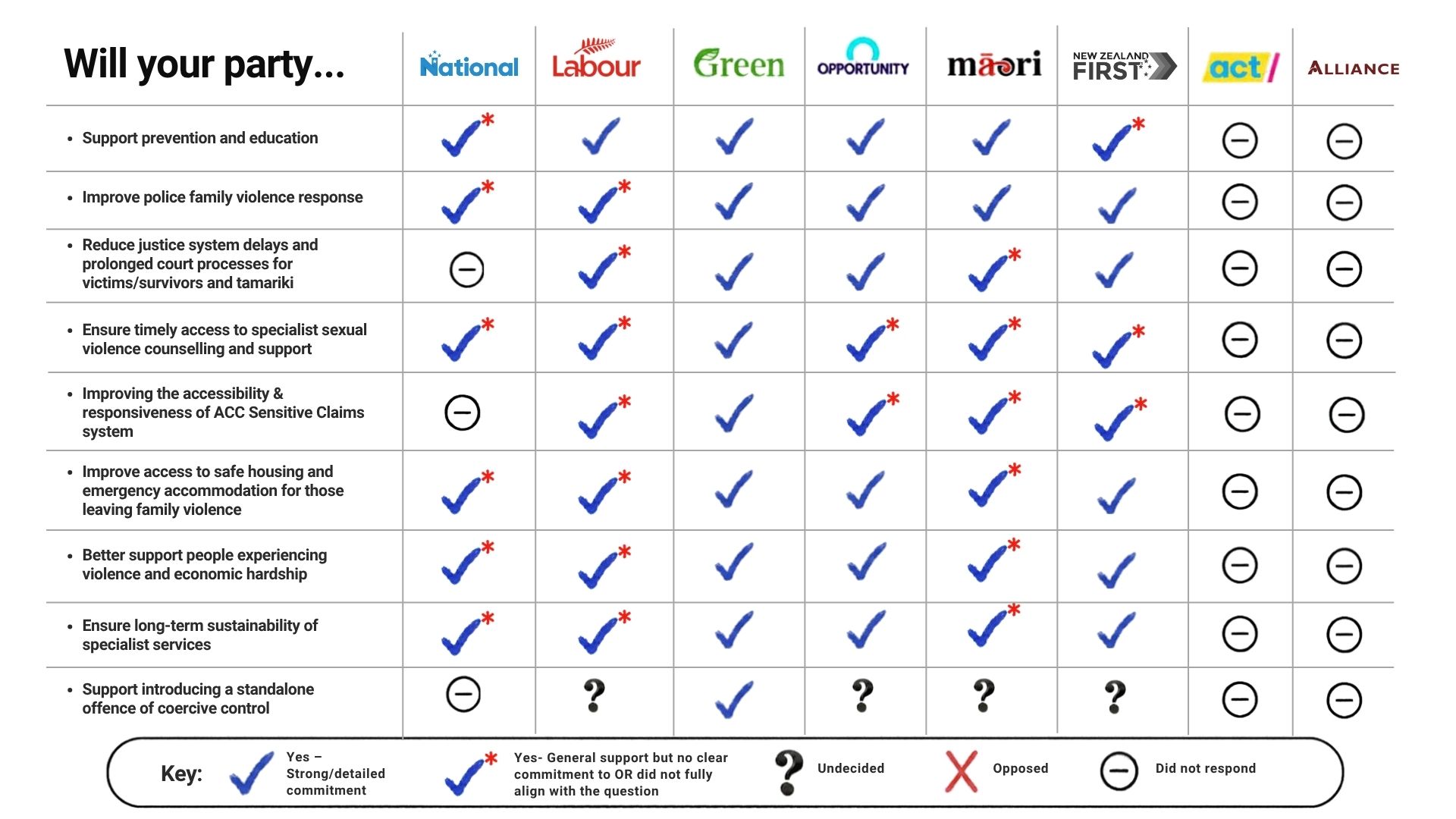
Parties were invited to respond to questions across nine key areas, including prevention, policing, justice, housing, sexual violence support, income support, service sustainability and coercive control.
Aviva does not endorse any political party. This initiative aims to support informed public discussion by providing transparent information about how parties would respond to issues affecting tāngata whaiora impacted by family violence and sexual violence.
 The issues raised
The questions were informed by recurring concerns identified by frontline practitioners, including access to safety, housing, counselling and financial support; delays in policing and justice systems; the sustainability of specialist services; and investment in prevention and education.
About the responses
All responses are published in a Flipbook to help readers compare party approaches and priorities. They are presented in the order received. Where parties did not respond, this has been noted. Responses have been published as provided, with only minor formatting changes for readability and accessibility.
How each Political Party responded
Click each topic tab to view Aviva's questions and the responses from the six political parties that chose to participate.
Responses received- Labour Party: 22 September
- Green Party: 22 September
Response Deadline: 23 September - Te Pāti Māori: 24 September
- National Party: 25 September
- Opportunity Party: 28 September
- New Zealand First: 7 October
- ACT Response: No response received
- Alliance: No response received
Download all party responses received (597kb PDF)
1.a. What do you see as the most urgent family violence and sexual violence issues facing Aotearoa?
Labour Party Response:
Labour is deeply concerned about the rate of sexual violence in New Zealand and the lack of justice available to most survivors.
Green Party Response:
Aotearoa still has unacceptably high rates of intimate partner violence, sexual violence and child abuse and sadly this looks to be increasing rather than coming down.
And yet this government has ordered funding cuts to both public and NGO organisations who are supposed to respond to family violence and sexual violence. This leaves impacted people with less options to seek help.
There desperately needs to be a renewed focus and resourcing of primary violence prevention work that is informed and led by the expertise of the sector and with the support and authentic partnership with government agencies. The Green Party acknowledges that this current Government have de-prioritised the work to end violence – as seen by their failure to allocate a single new dollar of funding through this entire parliamentary term, to Te Aorerekura, the elimination violence strategy. This has placed enormous pressure on the community sector as public sector agencies appear to be shifting the responsibilities onto NGOs. But without any extra resourcing and often without the necessary information of the complex needs involved. I am deeply concerned about the safety and wellbeing of the workforce cross the sector as a whole. This also calls into question our nationwide capability and capacity to respond safely to violence.
Finally, although the family violence and sexual violence occurs across demographics, the sector have been clear that the lack of basic social supports in anyone’s life can hamper the chances for access to justice and accountability, safe support, healing and recovery. At a time of record unemployment, homelessness, material hardship and unmet mental health needs – we must urgently ensure people have what they need to live good lives that they feel in control of. Alongside our focus on affordable lives in the areas of housing, income, health, household bills, transport and jobs, our 2026 Manifesto explicitly focuses on key growing concerns:
- Inadequate resourcing of frontline family and sexual violence organisations.
- The need for improved prevention, healing, recovery, accountability and restoration approaches.
Te Pāti Māori Response:
Te Pāti Māori whole-heartedly acknowledges and agrees with the overview/key messages outlined by Aviva its briefing to decision-makers. We share Aviva’s concerns regarding;
- Reduced police capacity and inconsistent responses to family violence
- Justice system delays that prolong trauma and slows recovery
- Housing instability and barriers to emergency accommodation
- Reduced access to sexual violence counselling and ACC changes
- Cost-of-living and income support pressures increasing risk
Taken together, our starting position is that these challenges have been exacerbated by wholesale changes to government policy which has opted for a “tough on crime, economy over people” approach and not community prevention and support for victims
National Party Response:
Note: The National Party did not respond directly to each question. The statement provided condemns family and sexual violence but does not identify the most urgent current issues.
Opportunity Party Response:
Opportunity recognises the scale and seriousness of family and sexual violence in Aotearoa. We see the most urgent issues as preventing violence before it occurs, keeping victim-survivors and children safe, and ensuring that the health, justice and social service systems work together to reduce violence and re-victimisation.
Ultimately, we need to move from a system that too often responds after serious harm has occurred to one that prevents violence, intervenes earlier, protects victim-survivors and children, reduces re-victimisation, and uses evidence to determine where investment can make the greatest difference.
New Zealand First Response:
The most urgent issues are the high rates of domestic and sexual offending, long justice system delays, and the severe harm inflicted on victims and children. NZ First views stopping family violence and protecting vulnerable Kiwis as paramount for community safety, public health, and law and order.
ACT Response:
No response received
Alliance Response:
No response received
1.b. What are your party’s top priorities over the next parliamentary term to reduce family violence and sexual violence?
Labour Party Response:
Labour is committed to taking the following measures to address sexual violence:
- Using primary prevention strategies to stop sexual violence before it happens by confronting dominant cultural norms—beliefs, attitudes, and behaviours that make rape and sexual abuse possible—and to promote and increase positive behaviour and ways of relating to replace sexual violence.
- Reviewing possible reforms to improve the criminal justice system's approach towards sexual violence, taking into account research that reflects the prevalence of sexual violence against women and children, and the cultural issues surrounding the reporting of sexual violence in some communities.
- Educate communities about what constitutes sexual violence, how to report it to the appropriate authorities, and how the justice system protects and supports survivors—all of which will encourage the reporting of sexual violence.
- Create a well-funded and resourced support network for survivors of sexual violence, beginning with initial support when sexual violence is reported through to meeting the long-term needs of the survivors.
Green Party Response:
Our key priorities as outlined in our 2026 Manifesto are:
- Fund the implementation of the action plan for Te Aorerekura: National Strategy to Eliminate Family Violence and Sexual Violence, centred on Te Tiriti.
- Resource kaupapa Māori solutions and community-led solutions to family and sexual violence, that have been developed by disproportionately impacted groups, including women, Pasifika, rainbow, and disabled communities.
- Prioritise violence responses and prevention by improving workforce and broader public understanding of the drivers and signs of violence, and how to respond in ways that enhance safety and healing.
- Amend the Crimes Act to criminalise coercive control, amend the definition of consent, and preclude a defence of reluctant consent to affirm that consent must be free and voluntary, and can be withdrawn at any time while ensuring these changes cause no further harm.
- Restore relationship and sexuality teaching guidelines — including education on healthy relationships, diverse identities and sexualities, and affirmative consent — in all schools.
- Increase funding for counselling and mental health support for victims, whānau, witnesses, defendants and legal professionals engaging in the justice system.
Te Pāti Māori Response:
Te Pāti Māori’s policy manifesto takes a holistic approach to the issues raised above. Specific policy responses to the issues raised can be found across our policy manifesto. We understand that that there are many intersecting issues that require a multi-pronged approach including, transforming the justice system, arresting housing instability and the cost of living.
National Party Response:
Note: The National Party did not respond directly to each question. The statement identifies consent law reform, removing good-character sentencing discounts, continuing Te Aorerekura and investing in prevention, although these are not presented as a comprehensive set of FV/SV priorities.
Opportunity Party Response:
Opportunity’s priorities would be to prevent violence before it occurs, protect victim-survivors and children, improve the response of the justice and support systems, and ensure investment is directed towards approaches that make a measurable difference.
Our “Smart on Crime” policy strongly prioritises prevention of harm. We propose to:
- Offer voluntary interventions as soon as risk factors are identified, starting with a child's very first Oranga Tamariki Report of Concern.
- Expand the capacity of programmes that provide sustained, whānau-centred support for at-risk young people like parenting courses, youth mentoring and trauma counselling.
- Grow specialist courts and expand programmes that work including the Young Adult List, Te Pae Oranga, the Alcohol and Other Drug Treatment Court and Rākau Ora.
- Target the real drivers of offending, including addiction, undiagnosed conditions like ADHD and FASD, and family violence and dysfunction.
- Regulate recreational use of cannabis to undercut organised crime and reduce youth incarceration
- In preventing sexual violence, we strongly support consent education being a standard aspect of all RSE.
New Zealand First Response:
For that, please wait for our manifesto to be published soon.
Our top priorities have been recruiting 500 new frontline police, prioritizing victim safety over offender rights in sentencing, and expanding funding for specialist NGOs like Women's Refuge. We also focus on accelerating court processes to reduce delays and delivering early intervention support for at-risk families.
ACT Response:
No response received
Alliance Response:
No response received
Prevention work, including education in schools and community settings, is critical to reducing family violence and sexual violence over the long term.
2.a. How would your party support and resource violence prevention work?
Labour Party Response:
Labour will invest in primary prevention strategies to stop sexual violence before it happens by confronting dominant cultural norms—beliefs, attitudes, and behaviours that make rape and sexual abuse possible—and to promote and increase positive behaviour and ways of relating to replace sexual violence.
Green Party Response:
Fully funding the implementation of Te Aorerekura and its action plans – including prevention, early intervention, and healing – is core to the Green Party’s plan for ensuring our homes whānau, and communities are free from fear and harm. This includes:
- Resourcing kaupapa Māori and community-led initiatives developed by affected communities, including women, Pacific, rainbow, disabled, ethnic and older communities.
- Using long-term, flexible commissioning that covers the real cost of delivery, reduces fragmented reporting and enables providers to adapt services to local need.
- Investing in evidence-informed relationship, consent and violence-prevention education in schools and communities.
- Building a skilled, culturally competent and sustainable workforce, including consistent risk and safety practice and training for frontline statutory workers.
- Funding evaluation, disaggregated data and lived-experience measures so investment can be redirected towards approaches that demonstrate safety, access, healing and reduced reoffending.
Te Pāti Māori Response:
Te Pāti Māori supports community-led solutions to community wellbeing pointing to Whānau Ora as a successful, evidence-based prototype. We agree that tamariki across our kura should have access to high quality education in relationships studies and safety as a part of a national curriculum. In keeping with our values, we believe every whānau and their tamaiti should have access to the information they require to live safe and healthy lives.
National Party Response:
Note: The National Party did not respond directly to each question. The statement refers to continued prevention programmes, social investment and greater investment in primary prevention, but provides limited information about future funding levels or delivery.
Opportunity Party Response:
Effective prevention requires action across health, justice, education and social services, including early intervention, education, addressing the drivers of violence, perpetrator intervention and effective support for victims and survivors.
We support a more consistent and evidence-based approach to prevention funding, with decisions informed by experts, survivors and evidence about what works. Our proposed 10-year cross-party Health Plan would provide greater stability and predictability for the health components of prevention and support, but sexual violence prevention should not be confined to the health system.
Opportunity sees violence prevention as a long-term, cross-government responsibility, involving health, justice, education and social services. We would move away from short-term funding cycles and towards more stable, predictable investment, while ensuring that funding is directed towards approaches that demonstrate results.
New Zealand First Response:
NZ First supports resourcing frontline community providers and NGOs directly rather than growing Wellington bureaucracies. We prioritize early intervention programmes, Family Start, and community-led initiatives that support healthy family environments before crisis points occur.
ACT Response:
No response received
Alliance Response:
No response received
2.b. What is your party’s position on the loss of national school-based prevention programmes such as Mates and Dates, and how would you ensure young people have access to consistent, evidence-informed education about healthy relationships, consent and safety?
Labour Party Response:
Labour believes it is important to invest in prevention programmes that are evidenced-based and work for all young people.
Green Party Response:
The loss of nationally available school-based prevention programmes is a serious setback. The Green Party would restore relationship and sexuality teaching guidelines in all schools and support nationally available, evidence-informed prevention that builds healthy relationships, teaches affirmative consent, recognises diverse identities and sexualities, challenges harmful social norms, and equips students and school staff to recognise harm and connect safely with specialist services.
I will want to work directly with schools and the sector to understand what the gaps are across our education approaches. When Mates and Dates was winding up, some of the concerns raised were about retaining the skilled workforce from the programme and whether the schools delivering the teaching guidelines was the safest and most effective strategy for young people. I’d want to hear back about how this is going.
Te Pāti Māori Response:
As above, Te Pāti Māori supports public promotion and resourcing for and by kura in educating tamariki in the importance of healthy relationships, consent and safety.
National Party Response:
Note: The National Party did not respond directly to each question. Their statement does not mention Mates and Dates, school-based prevention, healthy relationships education or consent education in schools.
Opportunity Party Response:
We oppose any one governmental cycle having the power to quickly reverse programs whose efficacy requires long-term planning and commitment. We specifically oppose reducing funding or access for healthy relationship education, and support reintegrating it earlier into standard curriculum.
New Zealand First Response:
We support refocusing school curricula on core academic fundamentals while ensuring young people receive age-appropriate, values-driven relationship and civics education.
As a conservative party, we believe that education about relationships and sex should begin at home with minimal school input using a blanket approach.
ACT Response:
No response received
Alliance Response:
No response received
Frontline services are seeing reduced police capacity and inconsistent responses to family violence incidents and protection order breaches.
3.a. What would your party do to improve police responsiveness to family violence incidents and breaches?
Labour Party Response:
Family violence is our national shame. While there has been encouraging signs of increased reporting and more prosecutions, there is still so much more work to do. We believe that if Police are stepping back, there needs to be funding for services to fill that gap.
Green Party Response:
Police is a specific area where I think we have gone backwards. Successive Police Commissioners have been signalling for some time that they want to return to ‘core policing work’ and that responsiveness to family and sexual violence is not what they see as core business. The issue is that they remain key to people seeking protection from harm. There will always need to be close working relationships and shared responsibilities between police and frontline harm organisations.
General trust in police is at threat, especially regarding their responses to harm. The next Police Minister will need to have trust restoration as a priority with some clear accountability measures.
The Green Party would improve police responsiveness as part of a nationally consistent, victim/survivor- and child-centred multi-agency model by ensuring that police resources are appropriately focused on reducing harm in our communities. Improving police responsiveness must side alongside the inclusion of specialist family violence capability, trauma-informed and de-escalation training, clear referral pathways to iwi and community providers, independent oversight, and monitoring of repeat referrals and whether victims/survivors report feeling safer after a safety plan is initiated.
Te Pāti Māori Response:
Our NZ police are clearly under pressure and we reject the new additions to their case-loads and resources which ties them up in policing the homeless and petty crime instead of fighting real crime and the drivers of crime. Our view is that policy must be freed up to the job the public requires of them. We will repeal legislation that takes the focus of police away from attending to family violence incidents and breaches.
National Party Response:
Note: The National Party did not respond directly to each question. Their statement says more Police officers have been trained but does not explain how responsiveness to family violence incidents or protection-order breaches would improve.
Opportunity Party Response:
Opportunity recognises that an effective response to family violence depends on victims being able to trust that when they seek help, their concerns will be taken seriously and responded to appropriately.
No services will ever be effective if we cannot train and retain competent workers. In the case of police, that means integrating family and sexual violence as part of their core training, addressing the concerns that have been raised in reviews of police response to call-outs, and paying police adequately so we stop losing them to Australia.
New Zealand First Response:
We will deliver on our commitment to train 500 new frontline police officers and double Youth Aid officers to ensure rapid incident response. We also support stricter bail laws, mandatory minimums for violent offenders, and enforcing immediate consequences for protection order breaches.
ACT Response:
No response received.
Alliance Response:
No response received
Survivors are experiencing long delays in investigations and court processes, often extending over several years.
4.a. What changes would your party make to reduce delays in the justice system for family violence and sexual violence cases?
Labour Party Response:
For Labour, victims and survivors are the priority for our justice system. We will work to increase support for victims and tackle the drivers of crime and violence with evidence-based policies. Labour is committed to significantly reducing domestic and sexual violence statistics and the level of reoffending by people who have previously been dealt with by the justice system. Our justice system should protect and support victims of crime and provide access to justice for all. Labour knows that a fair and just society is critical to giving New Zealanders the good life they deserve.
Green Party Response:
We would reduce delays in the justice system by reforming Family Court processes to effectively respond to family violence. This would look like supporting actions in Te Aorerekura to expand specialist courts, better resource community law centres, and expand trauma-informed justice approaches through Te Ao Mārama. In the longer term, the Green Party is committed to ensuring that court cases are resolved in a timely manner by increasing funding for the court system, increasing the number of judges and staff across the court system, and reforming court procedures to reduce delays. We would also work to reduce the cost of litigation and legal services by reforming court processes, reducing or abolishing court fees, and removing barriers to pro bono work.
Te Pāti Māori Response:
As with the police, the courts also experience significant back-logs in cases bought before them. We think there is an opportunity to transform the justice system and to support/empower community solutions in resolving and preventing crime locally.
National Party Response:
Note: The National Party did not respond directly to each question.
Opportunity Party Response:
Opportunity recognises that long delays can add significantly to the stress and re-traumatisation experienced by victim-survivors. We support expanding specialist sexual violence courts nationally. Specialist sexual violence courts have shown promising results, including reducing the time to trial start by around a third. We would support expanding this approach nationally and evaluating its effectiveness.
New Zealand First Response:
NZ First supports streamlining court administration, increasing judicial resourcing, expanding alternative dispute resolution, and utilizing digital pre-hearing processes. We focus on eliminating procedural bottlenecks, so family violence and sexual violence cases reach timely, fair resolution.
ACT Response:
No response received
Alliance Response:
No response received
4.b. How would you reduce the retraumatising impact of prolonged court processes on victim/survivors and tamariki?
Labour Party Response:
Labour is committed to modernising our courts and court structure in a principled manner with the aim of making it more effective, efficient, and responsive.
Green Party Response:
The Green Party would support providing expanded access to specialist advocates, counselling, healing and mental health support throughout the justice process, including by expanding trauma-informed and culturally safe court models, with specialist support for tamariki, rangatahi and whānau.
Te Pāti Māori Response:
By intercepting and reducing back-logs through deferral toward community justice solutions, such as Whānau Ora prevention services.
National Party Response:
Note: The National Party did not respond directly to each question.
Opportunity Party Response:
Opportunity believes the justice system should protect victim-survivors and tamariki from further harm while ensuring that cases are dealt with fairly and as promptly as possible. Per the above response, we support expanding specialist sexual violence courts nationally. Specialist sexual violence courts have shown promising results, including reducing anxiety and re-traumatisation for complainants.
Housing and emergency accommodation
New Zealand First Response:
We advocate prioritizing victim and child safety over offender rights, expanding the use of remote or pre-recorded evidence, and ensuring victim-survivors have access to legal aid. We also support prohibiting perpetrators from abusing court processes to cause further harm to victims and children.
ACT Response:
No response received
Alliance Response:
No response received
We are seeing survivors remain in unsafe situations due to a lack of accessible emergency accommodation and safe, affordable housing options.
5.a. How would your party improve access to safe housing for people leaving family violence?
Labour Party Response:
Labour would reverse the "caused or contributed to their own need" test for emergency housing, so no one fleeing violence is ever made to justify why they left a home that wasn't safe, and we'd keep building public housing so there's somewhere secure to go next.
Green Party Response:
The Green Party see safe housing as an essential part of family violence response and recovery. We are committed to expanding public, accessible, papakāinga, transitional and supported housing, including exploring guarantee rapid accommodation placement for people, especially young people, who cannot safely remain at home. We will create and fund priority pathways from crisis accommodation into secure long-term housing.
Te Pāti Māori Response:
Te Pāti Māori housing policy makes specific commitments towards alleviating emergency accommodation numbers and providing relief for whānau and victims who are entitled to support as citizens of the state.
National Party Response:
Note: The National Party did not respond directly to each question. Their statement refers to additional social homes and support for an organisation responding to housing insecurity but does not outline a specific access pathway for people leaving violence.
Opportunity Party Response:
Opportunity recognises that housing insecurity and family violence are closely linked. Women leaving violent relationships can face particular barriers to remaining safely housed as they are frequently primary caregivers. Women who are sole parents, older, and/or living with disabilities face increased vulnerability.
We support expanding funding for emergency accommodation, and strongly oppose the government’s move-on orders legislation.
New Zealand First Response:
NZ First supports expanding state and social housing stock, providing low-cost government loans to local councils for social housing, and supporting transitional housing initiatives. Our regional housing plans prioritize safe, immediate shelter for families escaping domestic abuse.
ACT Response:
No response received
Alliance Response:
No response received
5.b. What would you change to ensure support is available before people reach crisis point?
Labour Party Response:
Labour would fund frontline family violence and housing services properly so people can get help early.
Green Party Response:
We would shift support upstream through early identification, accessible community entry points and proactive outreach before risk escalates. This includes stable funding for kaupapa Māori and community-led prevention, specialist and healing services and joined-up referrals across health, education, police, housing and social services; stronger income support. Local responses should be shaped with iwi, specialist sectors and communities, with children and young people prioritised.
Stronger income support is also a critical prevention and intervention tool for family violence to reduce severe financial stress that can exacerbate domestic strain. That is why the Green Party has a long-held commitment to increase benefits to liveable rates, individualise benefit entitlements, abolish benefit sanctions, and ensure all whānau have access to safe, affordable housing.
Te Pāti Māori Response:
Te Pāti Māori’s justice and health policies propose a number of system-wide transformations aimed at prevention. Our manifesto proposes a number of changes to legislation and policy decisions around resourcing critical services for those in need.
National Party Response:
Note: The National Party did not respond directly to each question. Their statement provides funding figures for earlier intervention with vulnerable children and families and describes early investment as a way to prevent further harm.
Opportunity Party Response:
We would seek to raise people’s financial floor, regardless of whether they are working, to prevent people being entrapped. Opportunity’s proposed Tax Reset and Citizen’s Income would provide adults with a financial foundation, while the proposed Child Support Income would recognise the economic contribution of parenting and caring. Greater financial security can give women more genuine choices about leaving an unsafe relationship and establishing an independent home. Access to sexual violence support (including ACC)
Survivors are facing long wait times for ACC-funded counselling and barriers to accessing support.
New Zealand First Response:
We advocate expanding 0800 advice line services, strengthening early intervention social sector trials, and resourcing community networks like Whānau Ora and Plunket. Providing early family support and financial relief helps prevent escalation into crisis situations.
ACT Response:
No response received
Alliance Response:
No response received
Survivors are facing long wait times for ACC-funded counselling and barriers to accessing support.
6.a. What would your party do to ensure timely access to specialist sexual violence counselling and support?
Labour Party Response:
The Labour Party is committed to ensuring that ACC is responsive to the needs of people who are recovering from sexual violence. It was the previous Labour government that launched Te Aorerekura, a 25-year plan to eliminate family and sexual violence, and we will see how to strengthen the system further when in government.
Green Party Response:
The Green Party has long been advocates for removing systemic barriers for ACC support for victim/survivors of sexual violence. To ensure timely access to support, we would advocate for more a sustainable funding model in ACC to fund specialist sexual violence counselling, crisis support and long-term healing – including by expanding kaupapa Māori services.
Te Pāti Māori Response:
Along with ACC, our view is that the system-wide transformation of the broader health system is required to ensure timely access to specialist sexual violence counselling and support.
Our starting position is to preserve the work of ACC in providing entitlements to citizens and to prioritise this right to all.
National Party Response:
Note: The National Party did not respond directly to each question. In their statement specialist counselling access, waiting times and workforce capacity are not addressed.
Opportunity Party Response:
Opportunity believes that people who have experienced sexual violence should be able to access timely, specialist and appropriate support, without unnecessary barriers or having to wait until their situation reaches crisis point. As a small party outside Parliament we do not have specific policy on this matter, but recognise one of the greatest barriers is lack of specialist sexual violence counsellors. It is impossible to guarantee victims their right to specialist care if there are no specialists available, so we think improving all of these services begins with the ability to train and retain qualified workers.
New Zealand First Response:
We funded community-based mental health initiatives like Gumboot Friday ($6 million per year) to provide free counselling for young people. Wait for our manifesto for more details.
ACT Response:
No response received
Alliance Response:
No response received
6.b. How would you improve accessibility and responsiveness within the Sensitive Claims system?
Labour Party Response:
The Labour Party is committed to ensuring that the sensitive claims system works well for the people that need it. We’ve been concerned that the rate of sensitive claims has been decreasing over the last three years – If someone needs help recovering from sexual abuse or harm, they should get it.
Green Party Response:
We would support a reform of the Sensitive Claims system around timely, survivor-centred access. ACC should work with specialist sectors and people with lived experience to monitor access, safety, equity and recovery outcomes and address barriers quickly. We worked with the former Government on getting ACC to cover birth injuries and we are confident that we can build on this for survivors of sexual violence.
Te Pāti Māori Response:
In keeping with our values, Te Pāti Māori supports any reviews and proposals which address improving accessibility and responsiveness within the Sensitive Claims system.
National Party Response:
Note: The National Party did not respond directly to each question. In their statement the ACC Sensitive Claims system is not mentioned.
Opportunity Party Response:
Opportunity believes that people who have experienced sexual violence should be able to access timely, specialist and appropriate support, without unnecessary barriers or having to wait until their situation reaches crisis point. As a small party outside Parliament we do not have specific policy on this matter, but as above: all improvements must come from the ability to train and retain qualified workers.
New Zealand First Response:
We advocate reviewing ACC dispute resolution processes to ensure claims are client-centered, responsive, and resolved in a timely manner. We support removing rules that force victims of ongoing life-debilitating trauma to repeatedly submit redundant documentation.
ACT Response:
No response received
Alliance Response:
No response received
Cost of living pressures and income support settings are contributing to people being unable to leave unsafe situations.
7.a. What changes would you make to better support people experiencing violence and economic hardship?
Labour Party Response:
Labour has announced a variety of policies meant to help those experiencing economic hardship, such as free doctor's visits, a cap on public transport costs, and making sure supermarkets stop hiking prices unfairly.
Green Party Response:
The Green Party will guarantee a decent income for everyone and pay for it with a fair tax system, including by:
- Increasing benefits to liveable rates.
- Individualising benefit entitlements.
- Abolishing benefit sanctions.
- Expanding Working for Families.
- Overhauling recoverable assistance so urgent grants are available instead of loans.
- Working toward writing off MSD debt.
- Expanding affordable housing and transitional housing support.
Te Pāti Māori Response:
Te Pāti Māori’s cost of living policy sets out a number of measures that provide immediate, medium-term and long-term relief for whānau in need. Taken together alongside our tax policy, our starting position is to ensure that whānau keep more of their own money in their pockets by rebalancing the tax system to provide certainty of access to public services.
National Party Response:
Note: The National Party did not respond directly to each question. In their statement social investment and housing are recognised as relevant, but the response does not directly address income support or the financial barriers preventing people from leaving violence.
Opportunity Party Response:
Opportunity recognises that financial insecurity can make it much harder for someone experiencing family violence to leave an unsafe relationship and establish an independent life. Economic abuse can also deliberately undermine a person’s ability to become financially independent. Per our above response, Opportunity’s tax reset and Citizens’ Income is about raising people’s basic financial security.
New Zealand First Response:
NZ First is easing cost-of-living pressures through tax threshold adjustments, FamilyBoost credits, removing GST from rates, and reviewing benefit abatement levels. We support emergency financial assistance so economic hardship never prevents a victim from leaving an unsafe home.
ACT Response:
No response received
Alliance Response:
No response received
Specialist NGOs are increasingly absorbing risk and complexity due to system pressures, without corresponding increases in funding.
8.a. What role do you see for community-based organisations in the wider system response?
Labour Party Response:
Labour will support policy developed in consultation with stakeholders and based on international best practice to address family violence. Labour policy on family violence will be evidence-based and will acknowledge that gender inequality is a cause of family violence. We will identify those groups within society who encounter barriers to accessing support and tailor programmes to meet their needs.
Green Party Response:
Former Green Party MP Jan Logie initiated a Select Committee Inquiry in 2016 into the funding of sexual violence organisations, and was able to secure a massive funding boost to the sector. The Green Party are firmly on record for recognising that community-based organisations are core system partners. They bring trusted relationships, specialist expertise, cultural knowledge and local reach, and should help lead prevention, service design, delivery, risk responses and evaluation. Government should engage with purpose, incorporate victim/survivor and whānau voice, remove contracting and referral barriers, and support strong local governance with iwi, kaupapa Māori providers and specialist sectors. Lessons from effective local approaches should inform national improvement without displacing community leadership.
Te Pāti Māori Response:
Our view is that community-based organisations must be empowered to lead and that the government’s role is to adequately resource and empower these groups by removing barriers, including legislation that is not fit-for-purpose, nor enabling enough to allow community solutions to be delivered.
National Party Response:
Note: The National Party did not respond directly to each question. Their statement identifies frontline and community organisations as delivery partners and provides examples of organisations receiving social-investment funding.
Opportunity Party Response:
Opportunity recognises the critical role of specialist NGOs and community-based organisations in supporting people experiencing family and sexual violence. These organisations often have specialist expertise and trusted relationships with communities that are an important part of an effective response.
As a small party outside Parliament we do not have specific policy on this matter, but would include this question within our larger framework of advocating for minimum 10- year cross-Party frameworks (including funding) so organisations can plan and measure outcomes.
New Zealand First Response:
Community-based NGOs like Women's Refuge are the essential frontline backbone of NZs family violence response. They deliver tailored, compassionate, and culturally responsive care far more effectively than centralized government bureaucracies.
ACT Response:
No response received
Alliance Response:
No response received
8.b. How would your party ensure the long-term sustainability of specialist family violence and sexual violence services?
Labour Party Response:
As above.
Green Party Response:
Changing the funding model for specialist services would be a priority.
The Green Party will push for flexible and multi-year contracts that meet the real cost of safe service delivery and support workforce retention. Under our recently released Te Waonui a Tāne policy, hapū would also be able to use funding to commission their own specialist services in their rohe.
Te Pāti Māori Response:
In keeping with our values, Te Pāti Māori remains open to any reviews and proposals which address long-term sustainability of specialist family violence and sexual violence services.
National Party Response:
Note: The National Party did not respond directly to each question. Their statement refers to annual frontline funding and reducing administrative burdens, but does not commit to long-term contracts, full-cost funding or sustainable workforce investment.
Opportunity Party Response:
Opportunity believes specialist family and sexual violence services need stable, predictable and long-term funding so they can retain skilled staff, maintain specialist expertise and plan for the needs of their communities.
As a small party outside Parliament we do not have specific policy on this matter, but would include this question within our larger framework of advocating for minimum 10- year cross-Party frameworks (including funding) so organisations can plan and measure outcomes.
New Zealand First Response:
We support multi-year Crown funding agreements for core specialist providers, indexing service contracts to inflation, and reducing administrative compliance. We also support increasing tax benefits (up to 50%) for corporate givers to boost private charitable funding.
ACT Response:
No response received
Alliance Response:
No response received
Several Australian states have introduced standalone criminal offences for coercive control, recognising patterns of psychological, financial and controlling behaviour as serious forms of abuse. New Zealand currently addresses these behaviours through civil mechanisms under the Family Violence Act 2018 but does not have a standalone criminal offence.
9.a. Does your party support introducing a standalone offence of coercive control in New Zealand? If not, do you believe existing legislation provides sufficient protection and remedies for victims of non-physical abuse?
Labour Party Response:
Labour will have a renewed focus on domestic and family violence and preventing child abuse. Labour believes that our family law must be fair, responsive, and always focused on the best interests of the survivor. Labour seeks to break the cycle of abuse, experienced in many families, that prevents women and children realising their full potential. Labour is yet to release our policy on preventing family and sexual violence - that will happen closer to the election.
Green Party Response:
Yes, our 2026 Manifesto commits to amending the Crimes Act to criminalise coercive control.
Te Pāti Māori Response:
Te Pāti Māori takes family violence issues seriously and remain open to policy, legislative change or any other measure that ensures the wellbeing of whānau.
National Party Response:
Note: The National Party did not respond directly to each question. The response does not state a position on a standalone coercive control offence.
Opportunity Party Response:
Opportunity recognises that family violence is not limited to physical violence. Coercive and controlling behaviour, stalking, economic abuse and other forms of psychological abuse can cause serious harm, and our prevention and support systems need to recognise and respond to these forms of violence.
We are open to considering a standalone offence of coercive control, but we have not settled a final position on whether a new offence is the best approach. We would want to be guided by evidence and by survivors, communities and relevant experts. We would want to prioritise prevention and providing immediate resources to victims, rather than leading with a carceral approach.
New Zealand First Response:
NZ First supports examining a standalone criminal offence for coercive control to hold perpetrators accountable for non-physical, psychological, and financial abuse. We believe non-physical patterns of coercive behavior cause severe harm and require strong criminal deterrence beyond civil protection orders.
ACT Response:
No response received.
Alliance Response:
No response received
9.b. If a coercive control offence were introduced, which relationships should it apply to (e.g. intimate partners only, or also family members, carers and other close relationships), and what legal threshold would be required to establish an offence while protecting due process rights?
Labour Party Response:
As above.
Green Party Response:
We have not completed comprehensive work on the application of such an offense. However, initial engagement with some sector experts indicates the offence could apply to current and former intimate partners and to family or whānau relationships where one person can establish and maintain domination through a pattern of coercive or controlling behaviour. A Green Government would seek to undertake robust engagement with the sector before drafting any such legislation.
Te Pāti Māori Response:
As above, we remain open to advice on what the appropriate applications and thresholds should be on the matter.
National Party Response:
Note: The National Party did not respond directly to this question.
Opportunity Party Response:
Per the above response we do not have a final position on an offence of coercive control.
New Zealand First Response:
The offence should apply to intimate partners and close family/carer relationships where a duty of care exists. The legal threshold must require proving a deliberate, documented pattern of controlling behavior that causes serious psychological distress or fear, protecting due process.
ACT Response:
No response received.
Alliance Response:
No response received
9.c. What safeguards would your party put in place to minimise unintended impacts on vulnerable or marginalised communities and reduce the risk of misidentifying the primary victim or aggressor in complex family violence situations?
Labour Party Response:
As above.
Green Party Response:
Implementation must be designed to cause no further harm. Safeguards could include a pattern-based statutory definition; explicit recognition of entrapment, self-defence and resistance; specialist screening to reduce predominant-aggressor misidentification; trauma-informed and culturally safe training for police, prosecutors, lawyers and judges; access to independent specialist advocacy; safe information-sharing rules; and regular review of charging, prosecution and outcome data.
Te Pāti Māori Response:
As above, we remain open to advice on appropriate safeguards and balancing misidentification of primary victims or aggressors in complex family violence situations.
National Party Response:
Note: The National Party did not respond directly to this question.
Opportunity Party Response:
Per the above response we do not have a final position on an offence of coercive control.
New Zealand First Response:
We advocate mandatory, specialized family violence training for Police, prosecutors, and judges to accurately assess risk patterns and primary aggressors. Clear operational guidelines and standardized risk tools ensure primary victims are protected rather than misidentified.
ACT Response:
No response received.
Alliance Response:
No response received
9.d. What maximum penalty would your party support for coercive control offences?
Labour Party Response:
As above.
Green Party Response:
We do not have a position on a maximum penalty. However, we note that our broader position aims to balance gaining justice for victim/survivors while ensuring that sentencing prioritises rehabilitation over punitive approaches.
Te Pāti Māori Response:
As above, we remain open to advice on an appropriate maximum penalty for coercive control offences.
National Party Response:
Note: The National Party did not respond directly to this question.
Opportunity Party Response:
Per the above response we do not have a final position on an offence of coercive control.
New Zealand First Response:
We support robust maximum penalties consistent with serious domestic violence offences to reflect the severe harm of long-term psychological abuse. Penalties should include imprisonment and mandatory participation in accredited perpetrator rehabilitation programmes.
ACT Response:
No response received.
Alliance Response:
No response received
9.e. What funding, training and other resources would your party provide to Police, the judiciary, specialist support services, community organisations and emergency housing providers to ensure effective implementation and meet any increased demand?
Labour Party Response:
As above.
Green Party Response:
Any legislation to criminalise coercive control must be complemented with:
- National guidance and accredited training for police, prosecutors, defence and family lawyers, judges, court staff and specialist services.
- Resourcing for kaupapa Māori and community-led services to support safe identification, advocacy, referrals and long-term recovery.
- Dedicated, multi-year implementation funding separate from existing frontline service baselines.
- Baseline data, disaggregated monitoring and independent evaluation of misidentification, charging, access, safety and reoffending outcomes.
Te Pāti Māori Response:
This is where Te Pāti Māori’s policy manifesto is clearest: public services must be funded and supported appropriately to do the job the public requires of them. Te Pāti Māori will move swiftly to ensure that these critical life-line services receive the funding, training and resources they require to prevent, reduce and eliminate family and sexual violence.
National Party Response:
Note: The National Party did not respond directly to this question.
Opportunity Party Response:
Per the above response we do not have a final position on an offence of coercive control.
New Zealand First Response:
We would allocate dedicated operational funding for specialized Police and judicial training on coercive control dynamics. We also commit to expanding financial grants for frontline specialist NGOs, legal aid, and emergency housing providers to handle increased demand.
ACT Response:
No response received.
Alliance Response:
No response received
Aviva acknowledges and thanks all political parties that responded to our request for information. We also acknowledge the valuable contribution of Jennisa Patel in supporting the presentation of these findings.
For enquiries regarding this work, please contact Wendy Riley, Fundraising and Communications Team Leader, on 0223 157 954 or via email community@aviva.org.nz